Showing posts with label IT Strategy. Show all posts

Thursday, June 13, 2013

Future Of ITSM Industry

Today, we see that business strategy is not only driving IT strategy but in some cases are being driven by IT Strategy. In future we will see these ‘some cases’ becoming ‘many cases’. This would be a time when IT would be integrated with business. We have already seen this shift of focus from ‘alignment’ to ‘integration’ in ITIL V3. Also, this would enable IT to effectively address the continuous evolution of organizations and their policies. 

One of my earlier blog has covered how integration of IT with business can happen. 

I believe the future of IT would be driven by some of the key ITIL processes or some specific areas of the same that has not been in much focus across majority of organizations. Also, the tools that would be enabling these processes or areas and facilitate real time decision making would drive the business of Software Product Companies who have such tools in their product catalog. 

Some key areas that would drive the future of ITSM industry would be: 

  • Analytics: We have data everywhere. But today the reports or data analysis is predominantly being used to measure vendor performance and in other cases initiate service improvement plans (SIPs). We rarely see the ITSM data driving business decisions. Analytics would be a key for business enabling them to make real time decisions. 
  • Automation: According to Forrester, “Service Management and Automation” is one of the key things for future. Automation would drive customer-centric, service-focused, and automated IT operations. It would reinforce the fundamental that customers and services always come first. Besides, automation will allow IT organization’s support and delivery of IT services to be faster, cheaper, and of a higher quality. 
  • Proactive IT organizations: Currently we see that majority of IT organizations are highly reactive. Future IT organization would be highly proactive ones. 
  • Some ITIL processes would gain importance or would address some key areas which are not being effectively addressed in IT organizations today: 
    • Strategy For IT Services and Demand Management processes would enable organizations to innovate and plan to outpace competitors and meet demand.
    • Financial Management would ensure that value of IT services are defined and managed. It would act as a decision making process for development and delivery of IT services. It would gain even more importance in cloud environment since charging units, charge per unit and cost per charging unit has to be effectively determined besides billing the customer (and customer’s customer) based on consumption. 
    • Business and Service Capacity Management would gain prominence. Currently many organizations are managing capacity only at component level, i.e. they are having only component capacity management in place. 
    • Change Management and Service Asset & Configuration Management processes would have more emphasis on focusing Services as CIs and Service Changes (Practically Service is not being recorded as a CI by many IT organizations) 
    • Knowledge management would drive automation of management, control and facilitation of knowledge capture and sharing. 
    • Proactive problem management, not effectively followed in many IT organizations, would drive pro-activeness. 
    • Continual Service Improvement would gain focus so as to continually improve service performance and quality besides process efficiency and effectiveness

Saturday, December 17, 2011

6 ‘I’s Of Strategic Decision Making

Strategic Decision Making is a continuous process. There are various models for strategy generation (My Strategy Generation Model). But still a question that bothers us is - "How do we formulate and decide a strategy?"

I propose the following model for Strategic Decision Making. I prefer to refer to as "6I's of Strategic Decision Making"


My 6 I's are:
  1. Identification of problem: During this stage the problem for which the strategic decision has to be made is identified. he output of this stage would be the problem statement.

  2. Information processing: This is the stage where data gathering is done and information is processed. Referring to my model of strategy generation, this is the Strategic Assessment stage/phase. We analyze all external and internal factors, conduct appreciative enquiry and arrive at various objectives.

  3. Identification of options: The identified objectives will act as an input for identifying various options. From IT strategy perspective this would be the second phase of my strategy generation model, SITP Planning Process (rather even the 4th and 5th Is are related to it).
    Otherwise for identifying any strategic option, the objectives will be analyzed to identify the various ways or options by which it can be accomplished. The focus should be on identifying as many options that may be possible.

  4. Isolating a choice: After identifying various available options, the best one needs to be identified. There are various qualitative and quantitative techniques that may be used to isolate the choice. These methods would be discussed in my next post.This would also give measurable targets for the strategy or objectives.

  5. Implementation: After the choice has been identified/isolated, the implementation plan has to be formulated. Mintzberg's Plan and Pattern will act as an catalyst for formulating the Implementation plan. Thereafter, steps for implementation of the plan is performed, which would include allocation of required resources. Thus, resources and capabilities of the organization will enable in eventual implementation.

  6. Improvement via feedback: This is the feedback mechanism. Whether the implementation is inline with identified measurable targets or not is determined with regular feedback, gaps and corrective actions identified and implemented. Eventually when the required target is achieved, it would mean that the strategic decision has been able to successfully resolve the IT/business strategic problem.
It should be noted that strategic decision making is a cyclic process. Also, it may be possible that a strategic decision making for a new problem has to be initiated when one for the other is already at any stage of 6I. In such a situation we can find parallel implementation of 6I.

My 6Is of decision making can easily be related to the PDCA or Deming Cycle. Also, it should be observed that the problem statement referred to in this post is more of the business or IT issue or need that is in hand for which a strategic decision has to be made.

Sunday, December 11, 2011

IT Strategy Generation: Preparing For Execution

My model for strategy generation is in extension to the OGC's model. My model consists of following phases/stages:

Strategic Assessment:
We analyze the internal and external factors. We are conducting a SWOT analysis to identify our Strengths, Weakness, Opportunities and Threats. But at the same time the model focuses on SOAR. Thus, Weaknesses and Threats through analyzed and acting as an input to the assertive enquiry, yet there is not a major focus on the findings. These finding are more from the perspective of 'keeping an eye on'. This ensure that the benefits of SOAR is being realized along with not missing the concern areas during assessment and strategy formulation.

Based on the assertive enquiry, analysis of external & internal factors and the business strategy itself, the objectives are established.

Measurement and success criteria for measuring the successful implementation of these objectives are determined for each objective identified.


Strategic IT Planning Process:
This is the stage during which Strategic IT Plan (SITP) is prepared. This is based on the Mintzberg's 5 Ps of Strategy. OGCs model refers to only 4 Ps, but I have included the 5th P (Ploy) as well, since IT can act as a major enabler or creator of a Ploy.

Eventualy the SITP is prepared, which has all the required details about the IT Strategy. This acts as an input to Service Portfolio process of ITIL V3 as well.

Tuesday, December 6, 2011

Model For Intergrating IT With Business

We have come across with the shift in focus from Business - IT Alignment to Business-IT integration in ITIL V3. Service Strategy phase of the lifecycle, specifically Strategy Generation (or Strategy Management) process, talks about this integration.

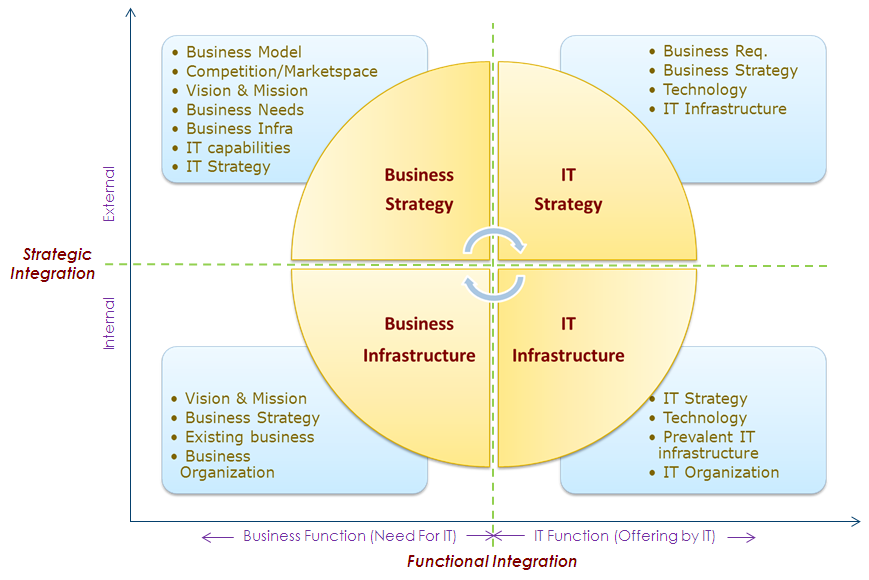
But a query in a practitioner's mind is always there - How to achieve this integration? I am presenting below a model, Business - IT Integration Model, which can help us with achieving this integration.

My model is in extension to the Business-IT alignment Framework (Proposed by: Henderson & Venkatraman).


My model takes into account the fact that traditionally:
  • Business Strategy drives Business Infrastructure
  • Business Strategy drives IT Strategy
  • IT Strategy drives IT infrastructure
This dependency of IT strategy on business strategy is resulting in the short term IT strategy and goals. In other words this is making it impossible to have a long term IT strategy.

Predominantly in many organization IT is still being treated as a cost center . 'Actual' value proposition of IT to business remains unexplored. This is so since IT is entangled with short term or immediate requests of business on a daily basis and is struck with playing a support role.

Value proposition of IT can only be realized when IT partners the business. This is where my model highlights that:
  • Business Strategy and Business Infrastructure drives each other: Strategy could be deliberate or emergent. In case of deliberate strategy, business infrastructure will provide the current state assessment and the defined business strategy will drive the business infrastructure that will be required to support it. On the other hand, although emergent business strategy may drive the business infrastructure but more often it would be the existing business infrastructure that would drive the business strategy.
  • Business Strategy and IT Strategy drives each other: We know that traditionally IT strategy is based on the business strategy. These IT strategies are short term. But having a long term IT strategy will enable effective business strategy. Whenever any strategy is defined various options are available and these options are to be evaluated. A well defined IT strategy can have a major influence during this process. This is where the business strategy would be driven by IT strategy.
  • IT Strategy and IT infrastructure drives each other: In the same way as business strategy and business infrastructure drive each other, IT strategy and IT infrastructure also drives each other.
  • Business infrastructure and IT infrastructure drives each other: Traditionally IT infrastructure is based on the requirements to support IT strategy and business infrastructure. This is where business infrastructure drives IT infrastructure. But when IT infrastructure is futuristic ,based on the long term vision of IT (or IT strategy), it would have the features to support the business which business itself may not have thought of. Thus, it would start driving the business infrastructure.
  • Evolution of Business/IT strategy and infrastructure is a continual process: The overall evolution of strategy and the infrastructure is a continual process and the continual improvement can be triggered internally by any of the four quadrants or externally (eg. competition, law, marketspace, etc.)