Showing posts with label ITIL. Show all posts

Sunday, October 5, 2014

Is ITIL For Your Organization?

Often people think “Is ITIL relevant for my organisation?”  The answer is that ITIL is relevant to all organizations that use IT. Today every organization is dependent on IT. Thus, ITIL is applicable to organizations across the following domains:


  • Airlines
  • Banking
  • Consulting
  • Defence
  • Education
  • Finance
  • Government
  • Healthcare
  • Insurance
  • Legal (LPOs)
  • Manufacturing
  • Media
  • Outsourcers
  • Publication
  • Retail
  • Service Providers
  • Tourism
  • Others…


Why An Organization Needs ITIL?
With globalization and increasing dependency of business on IT, the IT environment is getting even more complex day-by-day. Availability of IT services supporting the business is very critical for the survival of organizations. Thus, managing these services gains utmost importance and hence ITSM. Since ITIL is the most widely accepted framework for ITSM, it has to be adopted by IT support teams to ensure that quality and continuously improving & evolving IT services are available to support the changing business needs. It provides a structured approach to service provisioning alongside embedding discipline in the IT organization. This also helps in proactive risk assessment and thus its mitigation.

ITIL helps in developing a service culture in the organization. This ensures that a clear communication channel is established between the business and IT.

Tuesday, September 30, 2014

Need of ITSM

Overall complexity of IT is evolving with increased global scope and competition. Business is demanding more value even from their internal IT organizations. Besides, dependency of business on IT is increasing everyday which has made IT critical for success of the business. This has resulted in a shift of focus. In a number of organizations, IT is now being considered as a ‘Profit Centre’ instead of ‘Cost Centre’.

Thus, to ensure that IT is constantly able to deliver value effectively and efficiently, ITSM is the key. Today, every organization is investing in ITSM, trying to develop it as their capability and as a strategic asset.

Sunday, September 14, 2014

IT Service Management

IT Service Management or ITSM is the ‘subject’ of ITIL.  Before focusing on ITSM, it is important for us to understand the meaning of Service.

Service: Service is the mean of delivering value to the customer. It assists in achieving the results that customer* wants. It takes away the associated costs and risks from the customer, i.e. ownership of the cost and risks is transferred from customer to service provider**.

Key characteristics of a service are:
  • It enhances performance of the task it assists in delivering
  • It facilitates achievement of the outcomes desired by the customer
  • It reduces the effect of constraints that exists in service delivery

ITSM is the discipline responsible for management of IT services and systems. It includes set of processes and functions that are used to provide these services. It can be said to be the set of capabilities that an organization has which provides value to the customers in the form of services.

Let us consider the following example:

Couple of years back one of the banking institutions in India outsourced its entire IT infrastructure to one of the leading IT Service Providers. Charging was based on number of transactions that the bank performs. Cost of the entire IT infrastructure and its day-to-day maintenance was to be borne by the service provider.


Service provided by the service provider was ‘IT infrastructure provisioning’. This service facilitated the transactional requirements of the bank. The bank did not own the IT infrastructure or any risk associated with it. Thus, by availing the service, bank transferred the ownership of both cost and risk to the service provider.


* Customer is the one who pays for a service.
** Service provider is the organization or unit that provides the service. They can be internal (internal service provider) or external (external service provider) to the customer’s organization. 

Tuesday, June 24, 2014

Understanding ITIL Processes For Your BAU In Simple Terms

When your house plumbing develops some snag you would see the symptoms. There would be a water leakage or no supply of water to a tap. Especially in case of concealed pipes you may find dampness in your walls. These all are the incidents that indicate that there is something wrong with the plumbing. These incidents typically would reflect an underlying problem for which the root cause is not yet known.
You would call a plumber to identify what is wrong with the plumbing, i.e. to identify the root cause. This is Problem Management. Plumber might give some filler (like m-seal) or you yourself can opt for one which is a temporary workaround. This is Incident Management where your goal is to have an asap resolution. Though it can provide a relief in terms of stopping the leakage, but this does not resolve the problem. Please note that problem is different from incident (which may simply be an indicator of something major to come). Plumber would look into identifying the source of leakage. Now you have the error and identify how it can be rectified, i.e., the resolution. This is known error.
Some part would need replacement, i.e. change, which could be a pipe, tap or combination of multiple parts. Plumber would provide you the details of parts to be replaced. This is RFC. This detail has to be taken to a hardware shop and given to shopkeeper. This is change management. Plumber may give you a time when he would come and replace the fittings. This is forwards schedule of change. Shopkeeper will validate the details and check the fitment of the parts before giving it to you. Shopkeeper may give you multiple options along with information regarding cost, quality, etc. and seek your approval for a particular type or brand. This is CAB approval. All these constitute Change Management.

You will take this to your plumber who would change the fittings, test and ensure that there is no more leakage. This is Release & Deployment Management. In case there is any warranty for the parts, you would ensure that it is properly documented and stored. This is Service Asset And Configuration Management. 

Monday, June 17, 2013

Issues Facing ITSM Industry

Issues Facing ITSM Industry can be classified under the heads of 4 Ps of ITIL:

People: 

  • Extreme internal focus of IT and lack of business understanding. IT is often not able to demonstrate value to business. 
  • People need to engage more with business. 
  • Communication with business needs improvement. 
  • People need to constantly improve the quality of their work and deliverables.
  • In many cases lack of leadership capability is having an impact on transforming and professionalizing IT so that new behavior (expected from ITSM process adoption) is embedded in the organization. Lack of management support is also resulting in poorly adopted process culture (or no process culture at all). 


Process: 

  • More focus is required on customer interfacing processes and demonstrating ‘value’ from these processes. 
  • More focus is required on integration of processes such that benefits are maximized by implementing various processes including ITIL. 
  • Theory of adopted frameworks (ITIL, PRINCE2, COBIT, etc.) is not being translated into practice. It has been observed that in many cases the expected value from adoption is often not realized. Organizations refer to ‘implementing’ or ‘installing’ frameworks as opposed to realizing a behavior change.
  • Business demands and IT technology capabilities are in constant change. IT lacks the capability to be flexible and ensure continual alignment to business demands. Continual Service Improvement (CSI) is often not in focus when adopting and deploying frameworks. There needs to be more effort and energy in embedding CSI in the culture and behavior at all levels in the organizations. 


Product:

  • Need for automation of management, control and facilitation of knowledge capture and sharing.
  • Tools are not being adequately used to enable people and processes which can help in greater value creation.
  • Tools for strategic processes need to evolve to effectively address the demands of strategic layer of the organization 
  • BYOD is becoming a norm globally. ITSM processes have to evolve to effectively address the resulting concern areas. 
  • Rapid technology change 


Partner: 

  • Today IT organizations have a multi supplier environment. Organizations need to evolve their ITSM to address the intricacies of such an environment. Organization’s ITSM capabilities must broker and manage multiple suppliers and ensure agreements are aligned and properly managed as well.

Thursday, June 13, 2013

Future Of ITSM Industry

Today, we see that business strategy is not only driving IT strategy but in some cases are being driven by IT Strategy. In future we will see these ‘some cases’ becoming ‘many cases’. This would be a time when IT would be integrated with business. We have already seen this shift of focus from ‘alignment’ to ‘integration’ in ITIL V3. Also, this would enable IT to effectively address the continuous evolution of organizations and their policies. 

One of my earlier blog has covered how integration of IT with business can happen. 

I believe the future of IT would be driven by some of the key ITIL processes or some specific areas of the same that has not been in much focus across majority of organizations. Also, the tools that would be enabling these processes or areas and facilitate real time decision making would drive the business of Software Product Companies who have such tools in their product catalog. 

Some key areas that would drive the future of ITSM industry would be: 

  • Analytics: We have data everywhere. But today the reports or data analysis is predominantly being used to measure vendor performance and in other cases initiate service improvement plans (SIPs). We rarely see the ITSM data driving business decisions. Analytics would be a key for business enabling them to make real time decisions. 
  • Automation: According to Forrester, “Service Management and Automation” is one of the key things for future. Automation would drive customer-centric, service-focused, and automated IT operations. It would reinforce the fundamental that customers and services always come first. Besides, automation will allow IT organization’s support and delivery of IT services to be faster, cheaper, and of a higher quality. 
  • Proactive IT organizations: Currently we see that majority of IT organizations are highly reactive. Future IT organization would be highly proactive ones. 
  • Some ITIL processes would gain importance or would address some key areas which are not being effectively addressed in IT organizations today: 
    • Strategy For IT Services and Demand Management processes would enable organizations to innovate and plan to outpace competitors and meet demand.
    • Financial Management would ensure that value of IT services are defined and managed. It would act as a decision making process for development and delivery of IT services. It would gain even more importance in cloud environment since charging units, charge per unit and cost per charging unit has to be effectively determined besides billing the customer (and customer’s customer) based on consumption. 
    • Business and Service Capacity Management would gain prominence. Currently many organizations are managing capacity only at component level, i.e. they are having only component capacity management in place. 
    • Change Management and Service Asset & Configuration Management processes would have more emphasis on focusing Services as CIs and Service Changes (Practically Service is not being recorded as a CI by many IT organizations) 
    • Knowledge management would drive automation of management, control and facilitation of knowledge capture and sharing. 
    • Proactive problem management, not effectively followed in many IT organizations, would drive pro-activeness. 
    • Continual Service Improvement would gain focus so as to continually improve service performance and quality besides process efficiency and effectiveness

Saturday, May 11, 2013

Interpreting OGC-Capita Joint Venture

26th April 2013, the date which could possible go down into Service Management History as capitalization of ITIL framework. This very day OGC entered into a joint venture agreement with Capita, an IT outsourcing provider of UK, to form a new company that has not yet been named. With this the ITIL, PRINCE2 and other IP of OGC would be owned by this new company which would take the responsibility of commercially developing these IPs. The new company would be launched in January 2014. The commercial and other details regarding this venture are available at:


It is interesting that such a major news for Service Management industry got minimal news coverage outside UK. Also, I am a bit surprised why other IT giants or organizations like EXIN have not won this bid because they have a potential to pay much more than Capita did. Was it that these organizations felt that there would not be a significant RoI from this deal or was it something else which prevented, barred or disqualified them from this bid. Only OGC would have an answer to my question. My opinion is that definitely it is not a case where these organizations were not interested. Owning IPs from OGC with the likes of PRINCE2 and ITIL surely make a great business proposition especially when you get to own the IP, which would take an organization into a different playing field all together. So RoI and business sense is definitely there. Then how come Capita, comparatively an unknown company outside of UK, has won this bid?

My opinion is that this being an election year in UK could have had an influence on decision making. EXIN was a Dutch company. IBM, Accenture, TCS and the likes are neither British as well. So though it might have had made more business sense for UK government to go with these Giants yet it would have had a political fallout on the ruling party.

How Service Management Industry Would Transform Post The Joint Venture
Only future will unfold the eventual impact of this joint venture. But I believe as far as adoption of ITIL V3 framework is concerned, there would not be any significant impact till a time the new venture does not come out with a policy to charge royalty for using the framework, a decision which could possibly lead to the death of ITIL. We might see some new Service Management framework being released from Open Source networks.

ITIL has grown not simply because OGC owned and developed it. It happened because many professionals across the globe, irrespective of their corporate boundaries have contributed to its evolution into a de-facto framework for IT Service Management.

Now post joint venture era, would the same level of contribution happen to further evolve ITIL? I do not think so. On the other hand the new company might hire professionals to write the new version of ITIL or develop supporting peripheral materials. In both the cases the acceptance level which ITIL as a framework enjoys today would not remain the same.

Other factors which could be interesting would be:

Firstly, the IT service providers who have a major contribution towards using the certification scheme may decide not to accept the ITIL certifications. This could happen because the money they would spend on getting their resources trained or certified would indirectly be funding their potential competitor.

Secondly, IT service providers and ITIL Consulting companies would start facing a severe competition from Capita in the ITIL consulting/implementation space since Capita would go to customers and claim that they own ITIL and no one can provide a better consulting/implementation solution than them. This again could be deterrent for such companies to accept ITIL’s evolution and thus contribute towards an open source Service Management framework.

Thirdly, the certification bodies like EXIN, APMG, etc. or ITIL Consulting Companies like Pink Elephant, Quint, QAI, etc. may decide to come out with their own certification scheme which could be based on an open source or their proprietary Service Management framework.

With all possibilities I see a major decrease in the revenue from ITIL certification and evolution of ITIL framework. Thus, this joint venture might possible fail on a long term and OGC would have a stiff competition from a new open source service management framework.

Monday, April 16, 2012

Controlling Unauthorized Changes

I have frequently come across a question – “How can we control unauthorized changes?” Some of the most common response that I have come across are:
  • Discovery tool can help in identification of the change of state, which if not approved would mean the change is unauthorized. This is reactive; in reaction to a change that has already been implemented. It can help us in identifying the unauthorized changes that has already been implemented, in case that change of state is being monitored. But if that change fails, the impact to the business would have already happened.

  • We need to embed process culture to ensure that everyone follows the defined processes and policies. Again a reactive approach if one is aware that unauthorized change has taken place. May be it can help in minimizing the probability when implemented with a severe penalty clause whereby it would be a deterrent for an individual to go against the defined process or policy. But there is a saying “Thief is not a thief till one is caught stealing”. Same applies to unauthorized changes. Many organizations realizes that unauthorized change has taken place only when that change fails and impacts the business.
  • Many have voiced the combination of the above two to eventually ensure that unauthorized changes are not implemented.
Then, what can be a pro-active way whereby change management can ensure that an unauthorized change does not take place?

To answer the above question, IT Security Management process has to be tightly integrated with Change Management. As part of the IT security process and policy definition, a security policy has to defined whereby ‘write’ access to the production environment can be granted to the concerned stakeholders, including the ‘administrators’ only when a change is approved and the concerned stakeholder is responsible for the change.

The defined security policy would be implemented by Access Management. Granting and revoking access can be automated by linking the approved change, implementer ID and change schedule with the access control application.
This process would ensure that no one has the access to the environment unless the same is approved by change management, which would be an approved change request. Thereby, proactively making certain that only approved changes are implemented to greater degree of accuracy (an approved stakeholder can still make some change which is not approved in the environment one has access to for implementing an approved change but such instances would be extremely rare)

Tuesday, December 6, 2011

Model For Intergrating IT With Business

We have come across with the shift in focus from Business - IT Alignment to Business-IT integration in ITIL V3. Service Strategy phase of the lifecycle, specifically Strategy Generation (or Strategy Management) process, talks about this integration.

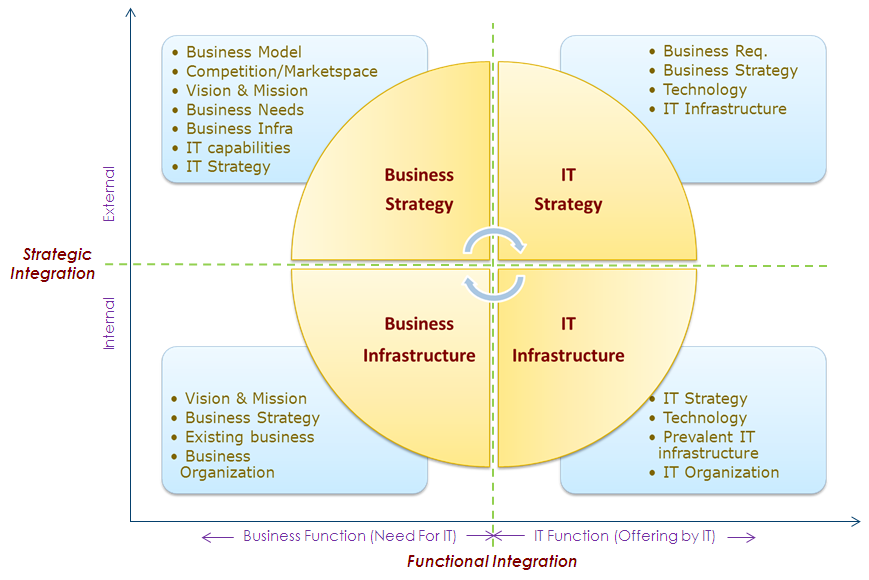
But a query in a practitioner's mind is always there - How to achieve this integration? I am presenting below a model, Business - IT Integration Model, which can help us with achieving this integration.

My model is in extension to the Business-IT alignment Framework (Proposed by: Henderson & Venkatraman).


My model takes into account the fact that traditionally:
  • Business Strategy drives Business Infrastructure
  • Business Strategy drives IT Strategy
  • IT Strategy drives IT infrastructure
This dependency of IT strategy on business strategy is resulting in the short term IT strategy and goals. In other words this is making it impossible to have a long term IT strategy.

Predominantly in many organization IT is still being treated as a cost center . 'Actual' value proposition of IT to business remains unexplored. This is so since IT is entangled with short term or immediate requests of business on a daily basis and is struck with playing a support role.

Value proposition of IT can only be realized when IT partners the business. This is where my model highlights that:
  • Business Strategy and Business Infrastructure drives each other: Strategy could be deliberate or emergent. In case of deliberate strategy, business infrastructure will provide the current state assessment and the defined business strategy will drive the business infrastructure that will be required to support it. On the other hand, although emergent business strategy may drive the business infrastructure but more often it would be the existing business infrastructure that would drive the business strategy.
  • Business Strategy and IT Strategy drives each other: We know that traditionally IT strategy is based on the business strategy. These IT strategies are short term. But having a long term IT strategy will enable effective business strategy. Whenever any strategy is defined various options are available and these options are to be evaluated. A well defined IT strategy can have a major influence during this process. This is where the business strategy would be driven by IT strategy.
  • IT Strategy and IT infrastructure drives each other: In the same way as business strategy and business infrastructure drive each other, IT strategy and IT infrastructure also drives each other.
  • Business infrastructure and IT infrastructure drives each other: Traditionally IT infrastructure is based on the requirements to support IT strategy and business infrastructure. This is where business infrastructure drives IT infrastructure. But when IT infrastructure is futuristic ,based on the long term vision of IT (or IT strategy), it would have the features to support the business which business itself may not have thought of. Thus, it would start driving the business infrastructure.
  • Evolution of Business/IT strategy and infrastructure is a continual process: The overall evolution of strategy and the infrastructure is a continual process and the continual improvement can be triggered internally by any of the four quadrants or externally (eg. competition, law, marketspace, etc.)

Wednesday, September 28, 2011

Letter from the author

Dear Readers,

My first title "Tackling Roadblocks During IT Implementation" is now available.

To unravel the mystries behind successful or failed IT implementation projects, buy my book today (Click Here)

I had been busy speaking at various forums to promote my book and hence there has not been any post from my side for quiet some time. I had a very interesting session at Project Management Institute, where I had delivered a session on "Managing ITIL/Process Consulting Engagements". I felt it would be something of relevance even in this forum. Thus, I am planning to come out with a series on what I had covered at PMI.

There has been some other interesting sessions at Computer Society of India, UKA University and Symbiosis.
Will be soon back with the next series for all of you.

Regards,

Sumit

Tuesday, May 17, 2011

Calculating SLA: Incident Management

Calculating the SLA adherence percentage for incidents seems to be a very simple task. But organizations struggle when they have to report on the same. One has to consider the open tickets, closed/resolved tickets and tickets that have breached the SLA.

Organizations have adopted different ways to calculate the SLA.

APPROACH I:
In Some organizations SLA is calculated based on the tickets they have resolved for the period. For example they have 10 tickets they have resolved of which 1 has breached the SLA, for them the SLA adherence would be 90%, i.e. they use the formula:
What they miss out here is that as a customer one would expect the breach to be reported in the report when the breach has actually happened and not when the breached ticket has been resolved. In this case SLA reporting gives all green whereas the reality is something different. This would also mean that in case one does not resolve the ticket that has breached the SLA, the SLA report will never reflect the same.


APPROACH II:
Another approach that organization takes is that they calculate SLA adherence based on the tickets resolved within the SLA and number of tickets created for that period. They use the formula:
In this approach although the SLA breaches are factored, yet the real picture is not presented as there would be tickets within the SLA that have not been resolved.


APPROACH III:
In yet another approach organization's calculate SLA adherence based on the tickets resolved within the SLA and number of tickets resolved for that period. They use the formula
In this approach although the SLA breaches are factored, yet again the real picture is not presented as there would be tickets that has breached the SLA and has yet not been resolved. Such tickets are not factored in the denominator.

Approach II and III will show a negative picture of the delivery as in both cases denominator tends to have a higher value.

There are other approaches similar to the ones discussed above used by organizations.

RECOMMENDED APPROACH:
When calculating SLA adherence, one has to factor the number of open tickets for a period, number of tickets that has breached the SLA and number of tickets carried forward from the previous reporting cycle. Considering these factors, I recommend the following formula:


In case one as to calculate SLA adherence for a particular period, start and end dates for the required period can be used instead of that for the week.

Thursday, May 5, 2011

Strategic Management & ITIL

Previous posts have helped us in understanding Strategic Management.

We know that Strategic Management helps in shaping or defining the organizational strategy. Today business is dependent on IT. So the actual translation of organizational strategy into business benefits for any organization will happen only when its IT is able to support the same. This is where Service Strategy phase of ITIL V3 becomes important. Thus, there is a very strong link between Strategic Management and ITIL.

Tuesday, March 1, 2011

Key ITIL Processes For Cloud Computing: Service Provider Perspective (Internal Facing) - Request Fulfillment

ITIL and Cloud Computing Series - Part 17

Request fulfillment is the process responsible for fulfilling service requests. Such requests are simply provisioned. These requests does not go through a formal change approval cycle.

But in cloud environment, the requests for addition, modification or deletion/removal of the existing capacity or resource has to be done in real time. Such requests are raised by the customer and provisioned without any change approval cycle. The request fulfillment team has to ensure that such requests are received in a complete manner and all required approvals, if any, from the customer side is provided along with the request.

Monday, February 28, 2011

Key ITIL Processes For Cloud Computing: Service Provider Perspective (Internal Facing) - Financial Management

ITIL and Cloud Computing Series - Part 16

With cloud computing the 'Unit' of charging has to be defined as charging is based on resource utilization, transactions, etc. Cost has to be properly allocated to different customers to ensure effective accounting and charge-back. Also, effective budgeting process would be required as all investments has to be strongly justified. The process has to be capable to provide details on return on investment (RoI) and total cost of ownership (TCO) of cloud services.

Saturday, February 26, 2011

Key ITIL Processes For Cloud Computing: Service Provider Perspective (Internal Facing) - Capacity Management

ITIL and Cloud Computing Series - Part 15

In the previous post I had discussed about the sudden surge in demand. The sudden surge in demand has to be fulfilled. Thus, the service provider has to ensure the availability of sufficient capacity. Not only that they have to maintain a balance between the utilized and excess capacity. Excess capacity would mean wastage of investment while the over utilized capacity reflects a potential threat for performance degradation. So capacity management and forecasting becomes a very complex and critical activity.

Capacity management has to be tightly integrated with supplier management process.

Wednesday, February 23, 2011

Key ITIL Processes For Cloud Computing: Service Provider Perspective (Internal Facing) - Demand Management

ITIL and Cloud Computing Series - Part 14

In a cloud environment there can be a sudden surge in demand. The probability of the surge will be much higher in public cloud. The provider has to be ready to provision such demands. Thus, effective mapping of demand trend and patterns of business activity (PBA) for every customer is required. The analysis of PBA and trend analysis will help in addressing the change in demand pattern. Also, this will help in identifying the ways to influence demand. A close linkage with capacity management and financial management is needed.

Tuesday, February 22, 2011

Key ITIL Processes For Cloud Computing: Service Provider Perspective (Internal Facing) - Service Asset & Configuration Management

ITIL and Cloud Computing Series - Part 13

Friends, first of all I am extremely sorry for being 'offline' for a considerable amount of time. I am continuing this series from where I had left.

SACM can be said to be the "heart" of ITSM. Any IT organization is dependent on accurate CMDB and Configuration Management System (CMS) for information. Each IT component of a cloud infrastructure has to be registered in the CMDB along with a well defined relationship. These IT components would be responsible for supporting many customers of the Cloud service Provider. So a failure of a single component has the potential to have a severe impact on many customers and thus the service provider.

Friday, October 15, 2010

Key ITIL Processes For Cloud Computing: Service Provider Perspective (External Facing) - Supplier Management

ITIL and Cloud Computing Series - Part 12

As Cloud Computing is all about real time provisioning, the supplier management becomes a very critical process for a cloud service provider. This is not only in terms of getting a good deal or price from their supplier but also in terms of having an excellent relationship so that they can fall back on their supplier as and when needed.

Saturday, October 9, 2010

Key ITIL Processes For Cloud Computing: Service Provider Perspective (External Facing) - Financial Management

ITIL and Cloud Computing Series - Part 11


From the service provider, Customers needs information related to the details of their utilization for which the service provider has billed them and would also prefer to get information that could help them in billing their internal customers. Thus, Service provider need to have a well defined and implemented process for Financial Management, supported by a good tool.

Thursday, October 7, 2010

Key ITIL Processes For Cloud Computing: Service Provider Perspective (External Facing) - Service Catalog Management

ITIL and Cloud Computing Series - Part 10

Entire service offering along with the relevant details for the offered services is part of a service catalog. Entire business of a cloud service provider would depend on their service catalog. Thus, it is one of the key processes.